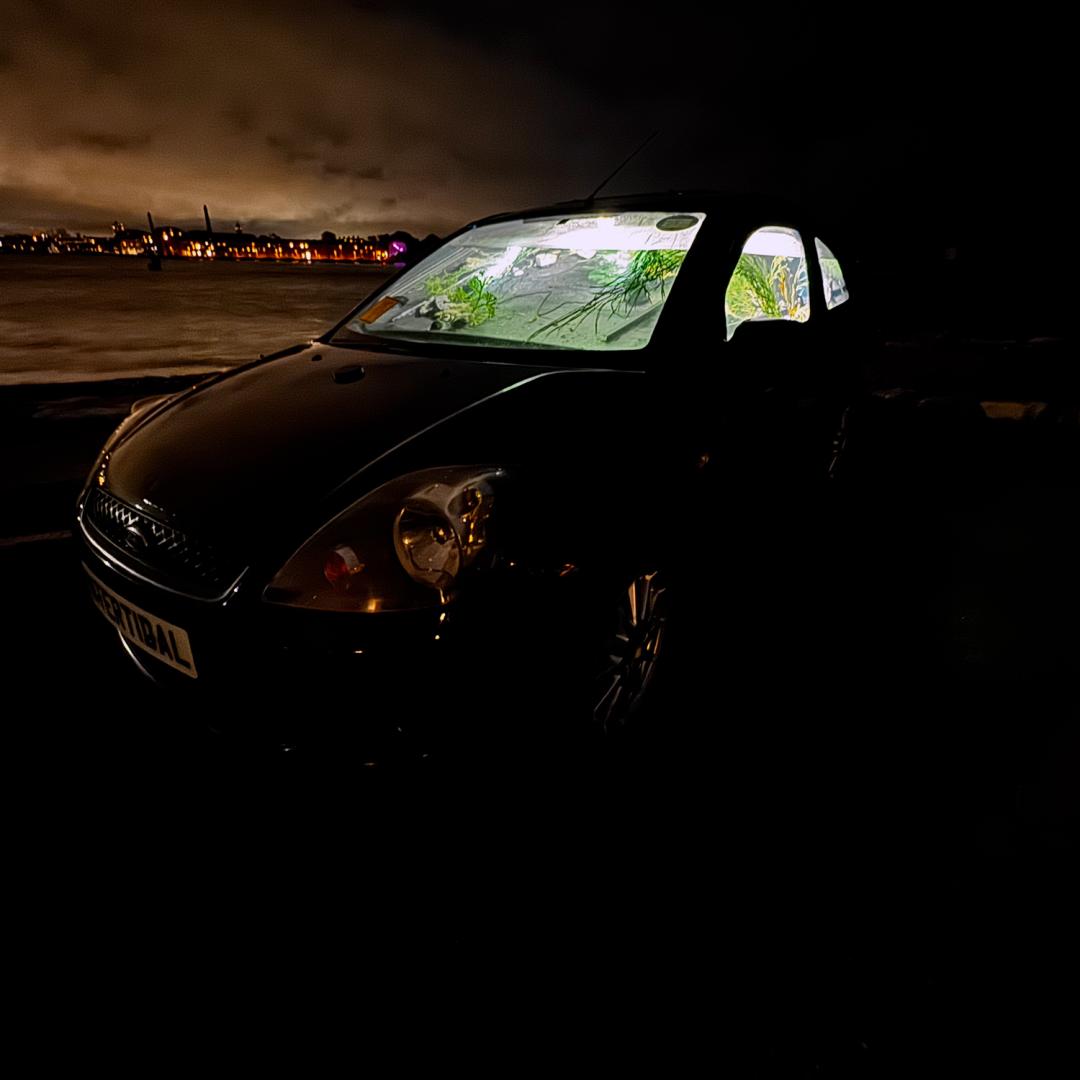
Intertidal
Date: 3rd September 2026Dimensions(m) 168 cm, 147 cm, 392 cm
Intertidal transforms four approximately 25-year-old Ford Fiestas into autonomous tidal instruments. The vehicles’ engines and interiors have been removed and replaced with reservoirs, pumps, sensors, filtration systems, batteries, software and digital controls. Using their location and tidal information, the cars move water between a concealed reservoir and the visible cabin, causing the internal water level to rise and fall with the changing tide in Plymouth Sound.
Travelling between 28 coastal, civic and residential locations across Plymouth, the vehicles bring the rhythm of the sea into the everyday fabric of the city. Their familiar appearance is gradually unsettled as the water within them becomes apparent. No longer governed by the systems for which they were manufactured, the cars reveal the influence of a larger environmental system extending beyond the apparent boundary of the shoreline.
Intertidal considers how the sea continues through and beneath the geography, infrastructure, culture and imagination of a coastal city. By displacing the tide into an object that might ordinarily pass unnoticed, the work creates a fragment of an intertidal environment in an unexpected place and asks a deceptively simple question: where does the sea really stop?
Intertidal was commissioned through Sea for Yourself, a programme led by Plymouth Culture in partnership with Plymouth Sound National Marine Park and Plymouth City Council. The project was realised with the generous support of The Heritage Fund, and Arts Council England.
The project was supported by a website designed and created by Ashley Hancock, which allowed live data to be sent and received by the installations: www.Intertidal.city
Materials:Mk5 Ford Fiesta cars, custom steel, fibreglass, and carpentry construction. 12 V DC electric systems, online interface, marine plumbing systems, three-stage filtration units.
The project was only made possible through the creativity, technical expertise, research, problem-solving and support of an extraordinary team of collaborators. Special thanks go to:
Blackwater Marina:
• Fibreglass and Carpentry: Danny and Dave Halley
• Steelwork: Mick Bennett
• Fabrication: Charlie Moore
• Project Management: Ian Wilson and Beccs Polden
TR2, Theatre Royal Plymouth:
• Production. Project Support, and Delivery: Seb Soper, Jason Steen, Matt Johns, Patrick Elliott, Brendan Cusack, Joe Marchant-Prouse, Ewan Thomas, and the TR2 Construction Team
API Interface Development and Web Programming: Ashley Hancock
EVParts:
• System Design and Custom Electronics: Brad Bunyard
• Node-RED Programming and Software Development: Seneda Nassir-Ali
Plymouth Marine Laboratory:
• Oceanographic and Tidal Research: Lee de Mora, Yaru Li and Thecla Keizer
Marine Biological Association:
• Marine Biology Research and Terrarium Testing: David Houghton, Alix Harvey, Katrina Houghton and Joe Feasey-Kemp
Additional Support
• Accommodation, Advice and Support: Adrian and Sally Sutton
Categories:
Algorithmic , Installation , Irritant , Public Realm , Sculptural , SeriesNews:
Intertidal - 03.09.26-28.10.26Sponsors:
